Large Exercise Mat vs Gym Flooring Tiles for a Home Gym
For bodyweight, cardio, HIIT and dumbbell work in shoes, one large mat beats interlocking tiles: no seams, no trip edges, and it rolls up. Here is when tiles still make sense.

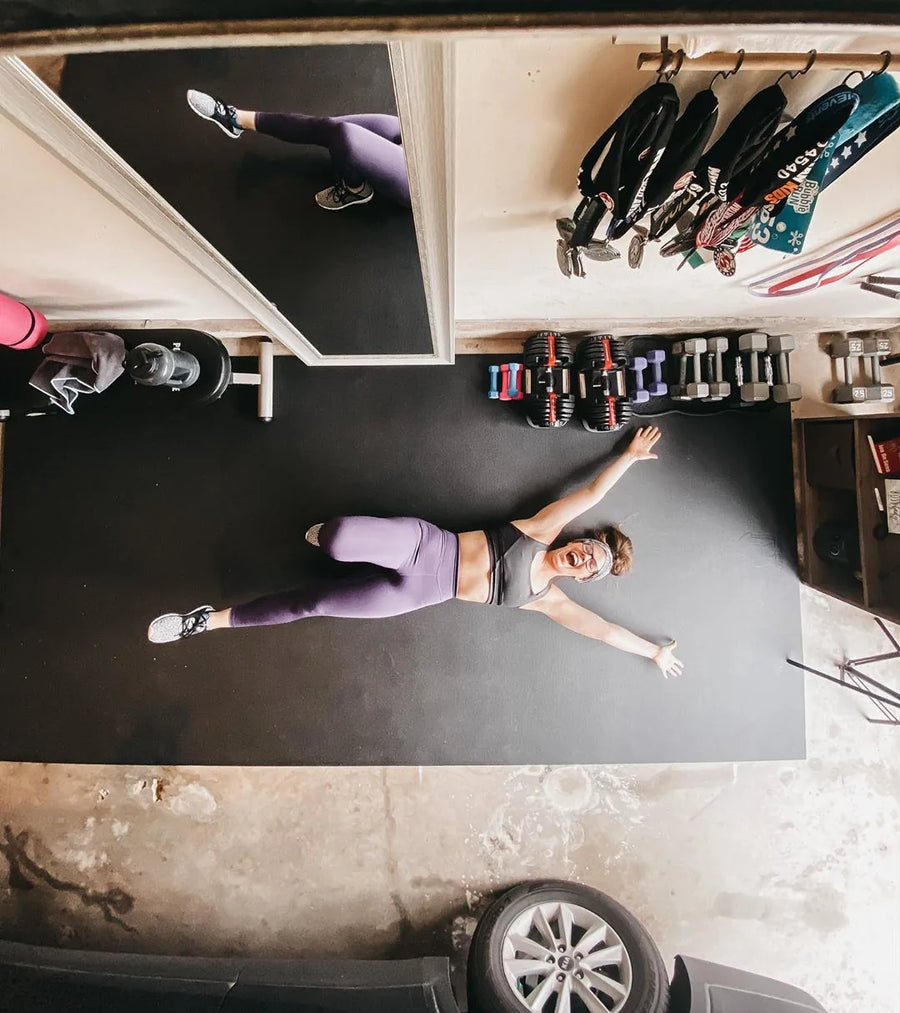
Short answer: for a home gym where you do bodyweight work, cardio, HIIT, and dumbbell or kettlebell training in shoes, one large exercise mat is simpler than interlocking tiles: no seams to separate, no edges to trip on, it rolls up when you need the room back, and it cleans in one wipe. Choose heavy stall mats or a lifting platform instead if you drop loaded barbells from overhead.
Key takeaways
- One mat: no seams to separate, no border pieces, rolls up in minutes.
- Tiles: fine for permanent wall-to-wall coverage.
- Dropping loaded barbells? Use stall mats or a lifting platform for the bar.
- 9' x 6' to 15' x 6' covers a spare room or garage bay.
Side-by-side
| One large exercise mat | Interlocking tiles | |
|---|---|---|
| Setup | Unroll it. Done. | Snap pieces together, add edge strips, cut to fit |
| Seams | None | Every 1-2 feet; can spread or lift with lateral moves |
| Moving or storing | Rolls up with straps and a carry bag | Take apart piece by piece |
| Cleaning | Wipe one surface | Sweat and dust collect in the joints |
| Covers a whole room | Up to 15' x 6' in one piece; combine mats for more | Any size, in pieces |
| Shoes and impact | Built for shoes, jumping, and weights | Depends on the tile |
| Heavy barbell drops | Not the right tool | Thick stall mats or a platform are |
“My old puzzle like mat was falling apart and every time I did a burpee or anything like it I would fall flat on my face because it would fall apart.”
Verified buyer · 5 stars · Large Exercise Mat
Where tiles fall short in a home gym
Seams move
Tiles hold together by their edges. Skaters, lateral lunges, and burpees push sideways on those joints, and over time pieces drift apart, curl at the edges, or pop up. A single mat has nothing to separate.
Edges are a trip hazard
The border pieces on a tile floor are where toes catch. A single mat has one flat, finished edge around the outside.
They are hard to put away
If your home gym is also your living room, guest room, or garage parking spot, you need the floor back sometimes. A Yo Gorilla Mat rolls up and stores in a closet, under a bed, or against a wall. Tiles have to come apart one by one.

They collect grime
Every joint is a groove that catches sweat and dust. A single mat wipes down with a damp cloth after a workout.
When tiles or stall mats are the better choice
- Olympic lifting and heavy deadlifts where loaded bars hit the floor. Use thick stall mats or a lifting platform under the bar.
- Very large, odd-shaped rooms you want covered wall to wall, permanently.
Many home gyms use both: a platform for the barbell, and a large exercise mat for everything else.
“it is so much better than those interlocking floor mats.”
Verified buyer · 5 stars · Large Exercise Mat
Can a mat go under equipment?
Yes. Our Exercise Mats work under treadmills, ellipticals, stationary bikes, squat racks, and benches. They cushion, protect the floor, and cut vibration and noise. Very heavy equipment may leave an imprint over time. A 9' x 6' or 12' x 6' mat leaves room for a machine and open floor space.

Which mat size for a home gym?
| Space | Mat |
|---|---|
| Corner of a room, one person | 6' x 4' or 7' x 5' |
| Spare bedroom gym | 9' x 6' |
| Half a garage bay | 12' x 6' |
| Nearly a full garage bay width | 15' x 6' |
More detail in What Size Exercise Mat Do You Need? and our Size Guide.
One mat. No seams. Rolls up when you need the room.
Free shipping, 60-day returns, and a lifetime warranty on every mat.
Shop Exercise MatsSee the Size GuideRelated guides: Do You Need a Mat for Dumbbell and Kettlebell Workouts at Home? · Exercise Mats on Hardwood, Vinyl Plank (LVP) and Tile Floors · The Best Mat for HIIT, Burpees and Jumping at Home
FAQ
Is a large exercise mat thick enough for a home gym floor?
For shoes, jumping, bodyweight training, and dumbbell or kettlebell work, yes. Our Exercise Mats are 1/4" (6mm) high-density (the 7' x 4' is 8mm), which absorbs impact while staying stable underfoot, and protects hardwood, tile, and concrete.
Will a big mat slide on my floor?
No. Both sides are non-slip. The circle-pattern bottom grips hardwood, tile, laminate, vinyl, concrete, and low-pile carpet.
Can I cover a bigger area with more than one mat?
Yes. Lay mats side by side. Their weight and bottom grip usually keep them in place, and mat seam tape holds the seam tight. That is two seams at most, not dozens.
What if it doesn't work for my space?
You have 60 days from delivery. We email a prepaid return label and refund the full price minus the return shipping cost. Every mat also has a lifetime warranty against defects.
More guides.
See all guides-
Jump Rope and Garage Gym Workouts on Concrete
How to jump rope and do HIIT on a concrete garage or basement floor: why to cover it, what mat size fits jump rope and full garage gyms, and setup tips.
-
What Size Exercise Mat Do You Need? A Simple Sizing Guide
Pick a mat at least 1 foot longer than you are tall and as wide as your arms reach side to side. Here is how to size a mat for your room, your body, and your workout.
-
Home Gym Gift Guide: The Best Gift for Someone Who Works Out at Home
Which mat to give, which size to pick when you don't know their room, gift ideas by person, and when to order for Christmas delivery.